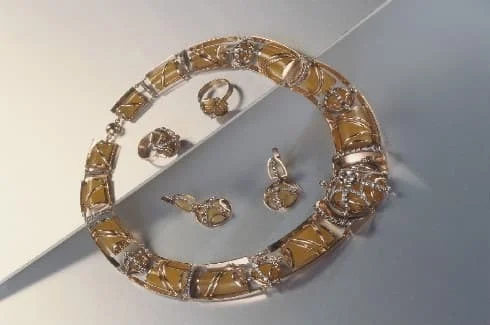
Gradually, mainly thanks to the promotion of amber within the „Ukrainian Amber World” project, interest in products decorated with this stone in the local market is growing.
Industrial development of Ukraine's amber deposits began in 1992, when by decree of the President of Ukraine, the exclusive right to mine amber was granted to the state. In 1993, the state enterprise for the extraction and processing of amber, Ukrjantar, was established, currently operating in Rivne under the name Amber of Ukraine.
The foundations of the amber processing industry were laid 16 years ago. The first decade of its development was very difficult – a monopoly on raw material extraction meant that it became a „state stone,” practically inaccessible to both educated artists and other creators. The industrial production of amber products by the Bursztyn Ukrainy company could only satisfy the unrefined tastes of the average consumer, and original designer pieces were lost in mass production or were intended as gifts for important guests. The few creators interested in this stone were entirely reliant on the tastes of their clients or the needs of the market. In such a situation, the pursuit of craft improvement, or drawing on the legacy of Polish, Baltic, or Königsberg masters, unfortunately went unnoticed. The deficit of new ideas, lagging behind current trends in global design and jewellery art, caused the fashion for amber ornaments to practically cease to exist. There was also a lack of a well-thought-out state policy regarding the development of the amber processing industry. It was practically impossible to find information about Ukrainian amber, both among producers and consumers. The paradox is all the greater given that amber is the only gemstone mined in Ukraine.
Individual works by talented jewellers, in which amber was the centrepiece of the composition, aroused great interest among specialists and won awards at exhibitions, but this had no impact on the overall condition of the Ukrainian amber industry. It was only after the lifting of the amber mining monopoly in 2005, increased interest in Ukraine from Poland and the Baltic countries, a sharp rise in the price of amber raw material, and the appearance of original and significant works by artists from the Baltic countries on the market that the process of shaping a modern amber market was significantly accelerated.
Following these changes, the company Bursztyn Ukrainy has also found its niche in the market in recent years, gradually creating its own school of amber processing. Artists are actively adopting and adapting the approach to amber cultivated in the Baltic countries to national traditions, which involves minimal intervention in the stone's original form, a principle that inherently shapes the entire composition. Projects have thus entered production where the preserved natural forms and texture of the amber play a dominant role. This stone is most often set in silver and gold, and also combined with leather and wood.
The developing amber market has also made room for small private companies that are trying to follow changing fashion trends. However, most of them operate exclusively in the domestic market – the presence of Ukrainian producers or amber jewellery designers at international trade fairs is still rare. The same applies to participation in international competitions and exhibitions – including those organised in Poland, Lithuania and Russia – in which Ukrainian creators usually do not participate.
Amber is gradually finding its admirers among creators of exclusive jewellery too. The natural characteristics of amber – such as its rich colour palette with subtle shades, variety of forms, and unique patterns – provide impetus for the creation of unusual combinations. In the works of the Classic Jewellery House Łobortas and Karpova, created in a new style for jewellery art, romantic avant-garde, this stone becomes the centre of the artistic image.
In 2007, at the initiative of the National Academy of Sciences of Ukraine and with the support of the Ukrainian Family Foundation, state, scientific, and commercial organisations, the national project „Ukrainian Amber World” was launched. Its aim is to promote Ukrainian amber both domestically and abroad. Within the framework of the project, artists representing various directions and styles, who have previously worked with different types of materials such as clay, glass, wood, metal, and fabric, are encouraged to work with this stone. For many of them, this is their first encounter with amber, which often results in a completely new approach and ideas for utilising its qualities.
The artists associated with the „Ukrainian Amber World” project have already achieved significant artistic successes, making it all the more interesting to follow their work with amber. The proposals from the Lobortas and Karpov Classical Jewellery House, HARARUK Design Studio, Jelegius Jewellery Design Studio, and artists from the „Ukrainian Amber World” project's Design Studio, specialising in ceramics, glass, metal, and stained glass, have once again confirmed amber's astonishing ability to combine with numerous materials, showcasing its unique beauty to the world in these often surprising compositions.
The activities undertaken within the „Ukrainian Amber World” project, aimed at popularising Ukrainian amber, have contributed to the creation of many significant works crafted in various fields of decorative and applied arts.
The author is the head of the department of precious stones at the State Gemological Centre of Ukraine in Kyiv.