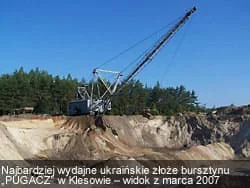
By a presidential decree in 1992, the exclusive right to manage amber was granted to the state. In 1993, the state enterprise UKRBURSZTYN was established in Równe with the task of extracting and processing amber.
The declaration of Ukraine's independence has led to a significant increase in interest in the issue of amber mining. By presidential decree in 1992, the state was granted exclusive rights to manage amber. In 1993, the state-owned enterprise UKRBURSHTYN was established in Rivne with the task of mining and processing amber.
In 1994, construction began on a factory with two specialised departments: jewellery and chemical (production of succinic acid). In May of that year, the first yield of domestic amber raw material obtained by the new state-owned enterprise appeared on the conveyor belts of the mine at the Klesów deposit. By the end of that year, 1,141 kg of amber was extracted, and 1,245 kg the following year.
After commissioning the processing plant in 1998, serious problems arose. It turned out that there was no demand for the chemical department's products, specifically succinic acid, which meant trouble instead of benefits. The complications associated with this lasted until the beginning of 2001, when by decision of the Committee of Ministers of Ukraine, UKRBURSZTYN was transferred to the State Joint-Stock Company UKRAINIAN POLYMETALS, which established a branch of its Lviv Jewellery Plant in the Rivne Oblast.
Annual amber extraction in 2000 amounted to just 400 kg, and the overdue debts of UKRBURSHTYN at the time of transfer to POLIMETALI reached 8.3 million hryvnias. The majority of the debt comprised the costs of building a succinic acid plant. To enable the continued operation of the mines and processing, the company POLIMETALI undertook a restructuring, after which all liabilities remained with the state-owned enterprise UKRBURSHTYN, while the assets were transferred to subsidiary companies: DP BURSZTYNOWE KOPALNIE and DP BURSZTYN.
The subsidiaries managed to significantly improve operations. Amber extraction increased and developed as follows in subsequent years:
| Lata | 2001 | 2002 | 2003 | 2004 | 2005 | 2006 |
| obtain (in tones) | 2,4 | 3,5 | 2,0 | 2,7 | 2,7 | 2,9 |
The production of finished goods also increased (approx. 5 hryvnias = 1 USD):
| Lata | 2001 | 2002 | 2003 | 2004 | 2005 | 2006 |
| value (mln UAH) | Good night. | 3,5 | 3,8 | 4,2 | 5,1 | 6,0 |
The range of jewellery products that skilfully utilise coloured varieties of amber (12 shades from white and greenish to dark cherry) and diverse design is systematically increasing. Pictures, icons, panels and portraits made from amber crumbs are the most popular. This applies not only to the local market – products are successfully sold in Poland, Belarus, Austria, Moldova, Italy and Spain (where icons generate the greatest interest).
In 2006, DP AMBER MINES and DP AMBER were merged again into a single state enterprise, UKRAINIAN AMBER, subordinate to the Ministry of Environmental Protection, which allowed for better coordination of the work of the extraction and processing departments.
The problem of illegal mining
Currently, the successful development of the enterprise is being hampered by the least expected cause – a shortage of good quality raw material. This is happening in a region rich in documented amber deposits. The “Pugacz” section of the Klesiów deposit alone, which is currently being exploited, is estimated by the Ministry of Environment to hold 85 tonnes, and the “Wilnie” section of the Dubrowickie deposit is estimated at 105 tonnes. Furthermore, in the three remaining sections where exploration work is being carried out, the resources are estimated at 65 tonnes.
However, currently only the “Pugach” section is being exploited and, despite the improvement of extraction methods through the introduction of a mobile bucket-wheel excavator, production remains far behind processing needs. At the same time, according to unofficial data, raw material is being exported outside of Poland, estimated at at least 10 tonnes of illegally extracted amber annually.
In 2005, the Verkhovna Rada of Ukraine made changes to the geological law, abolishing the state's monopoly on amber mining. In an interview given to the magazine “Economic News” (no. 210/112/2005) Director of PP. BURSZTYN Vladimir Medinsky states: “The establishment of new law is beneficial for amber mining, as well as for the interests of our company. It would be harmful to maintain a situation where the “black” part of the market is tens of times larger than the official one. Without adopting new rules, illegally mined amber will be exported to Poland and the Baltic countries anyway.”
In the first quarter of 2005, PP BURSZTYN sourced 30% of its raw material requirements. Director Miedinskij notes that the cost of sourcing raw materials for his company is rising rapidly: In 2003, PP BURSZTYN spent 0.5 million hryvnias on raw materials, and in 2004 this figure had risen to 0.98 million, whilst the volume of amber had increased by only 11%. In 2005, prices jumped by a further 18%.
Quote from W. Miedynski's statement: “Prices for raw amber and amber products have been rising since 2003, when Russia began reorganising the extraction of Kaliningrad deposits in order to create an artificial shortage of raw material supply on the world market.”.
Meanwhile, Volodymyr Tuckiy, director of the mining company AMBER MINES, has a less optimistic view on the impact of legalising private amber mining: “There won’t be fundamental changes. I doubt that companies engaged in illegal mining will want to register their activities. Believe me, after paying for licences, land use fees, covering reclamation costs and paying taxes, legalisation will probably not be profitable for anyone. I don’t think we face significant competition from private entrepreneurs.”.
In 2006, the problem of illegal amber mining was constantly observed by officials at all levels, the press and television. Perhaps the situation will change after the actions taken by the Minister of Environmental Protection, W. Dżarta, who, at the end of October, surveyed the Rivne Oblast and observed the chain of connections already known to the local authorities regarding the illegal mining, purchasing, and export of amber across the border. The Minister advocates for the maximum simplification of formalities when issuing mining concessions to private individuals or entire teams of diggers, who, in any case, extract significantly more raw material than PP BURSZTYN UKRAINY.
Following the simplification of the licensing procedure for private amber miners, PP AMBER OF UKRAINE should organise its own network of collection points, capable of accepting all private yields. Consequently, immediate decisions were taken to prevent further unauthorised amber extraction. To this end, the Ministry of Environmental Protection is preparing the following documents:
The Ministry of the Interior has been advised to address the issue of more effective action by law enforcement agencies in the field of amber resource use violations. Mobile protection units should be established, rewarded for their results in combating crimes in this area, and equipped with effective technical means. The Ministry of Finance will develop regulations for the purchase from private individuals of all usable minerals extracted by simple methods or collected during agricultural use.
This set of firm and coordinated actions by state bodies should lead to the prevention of further illegal exploitation of amber deposits and accumulations as early as 2007. This will allow small and medium-sized businesses to be included in the process of using natural resources and their processing, thereby creating broad opportunities for Ukrainian amber production to participate in the world market, both in terms of raw materials and finished products.
Wiesław Gierłowski