
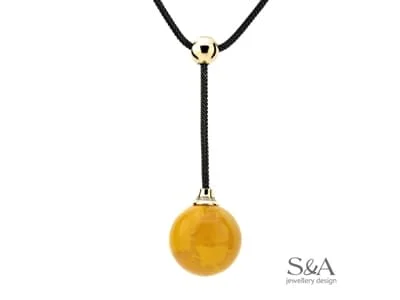
Who buys jewellery with amber today?
For the Polish amber industry, China is invariably the most important market - this market, although no longer as absorbing as before, will certainly be an important direction for at least a few more years. But it is not the only one - for the past year or so we have been observing a significant upturn in the European and American markets. The amber boom and the huge increase in the price of the raw material caused amber to be perceived as a valuable stone, and this in turn forced producers to treat it more prestigiously. And they did: today amber is set in gold and combined with diamonds and other precious stones, and jewellery decorated with it is in demand. Thanks to this change in approach, we stopped producing amber jewellery and started making jewellery with amber.
What is the difference?
In amber jewellery, the central element is the stone enclosed in a simple setting usually made of silver. Its buyers are mainly tourists looking for souvenirs from the seaside. However, amber jewellery is much more than that: its design is based on current world jewellery trends, it is distinguished by the high quality of precious materials and the use of modern goldsmithing techniques. It is jewellery that is bought for its undeniable visual and quality qualities and not because of the stone.
Is this already a trend in the Polish amber industry or, for now, only in the S&A?
It is my observation that invariably a very large proportion of manufacturers focus solely on the Chinese market. The fact that everyone today is trying to sell in China is resulting in supply far exceeding demand. Willingly or unwillingly, manufacturers, dissatisfied with their commercial performance, will soon have to turn their attention back to the European and US markets. S&A has never really abandoned these markets - sales to China have never accounted for more than 50% of our production. We had already made the decision to interest the Chinese customers there in modern amber jewellery a few years earlier. We focused on quality and design to attract a larger customer base from these markets. With a more fashion-forward view of amber, we gained a new group of customers: women 25+.
Has the investment paid off?
Yes, you can see it in the increase in sales. It was really a very big undertaking: the preparations took 3 years. We travelled a lot to different trade fairs around the world and collected impressions, we went in depth, we talked a lot with buyers. On this basis, new successful collections were created. The UK was the first to react positively to the new image of amber jewellery, followed by Germany, which is a very demanding market and tends to prefer classics, and the USA, which needs more colour, so we continue to combine different colour varieties of amber. Positive signals are also coming from France, and Spain is also coming back into the game. We have noticed that what is good for the German or British market will also find amateurs in other markets. Generally speaking, trends are universal - you just have to skilfully implement them into amber jewellery.
Marzena Leś is export director at S&A, which is the largest producer of amber jewellery in Poland.