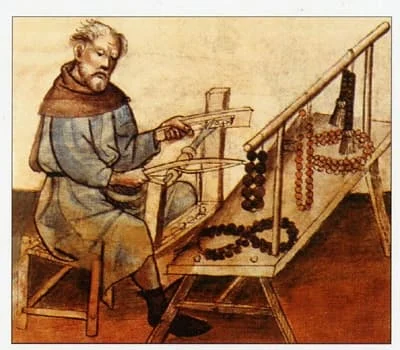
In Gdansk, they settled in the Right City (from 1350). In 1526, 46 craftsmen were known, which turned out to be a high number for the profession; the guild authorities therefore applied to the city council to limit the number of operating workshops to 40. The guild felt that the number of masters was too high and therefore restricted the admission of new members. They waited for an old master to die, for a place to become vacant, and then the first on the waiting list had the opportunity to become a member of this, after all, elite guild. This was the case, for example, in May 1558. Many journeymen never became masters. It was not just a matter of freeing up a place, but of minimum wealth, as membership cost money. Thus, the amber non-chamber craft flourished, especially in the 17th century, a period of exceptional flourishing of this manufacture. Off-site workshops were located in suburbs and suburban settlements, e.g. in Gdansk on land belonging to the bishops of Kujawy (Scots), to the abbots of Oliwa and by the city's monasteries.In 1637, one workshop was located on the grounds of a Dominican monastery.
It is also worth recalling that the master Krzysztof (Christoph) Maucher, creator of the magnificent and world-famous Malbork casket, was in Gdańsk a part-timer and royal servant who did not belong to the guild. During “raids” on part-timers, the guild authorities seized their workshops. It was less about the equipment, which was after all modest: a table with a hand lathe attached, a set of sharp knives, whetstones and files, but rather about the raw material and the psychosis of harassment. A description of a visited amber workshop was left by the Gdańsk resident Jerzy (Georg) Schröder in the mid-17th century.
Conditions for entry to apprenticeship and master's work (major)
In the oldest, founding ordinance of the Gdansk guild (1477), the rights and duties of members were clearly defined. The ways of selling goods, the required authorisations to run a workshop and, above all, admission to the guild were specified. The guild with associate members with the character of a craftsmen's brotherhood defended its rights and fought off competition. The basic document required from a candidate for a master was a certificate of rightful and free birth, followed by a baptismal certificate and a certificate of graduation for locals and a certificate (reference) from the last place of service - for strangers. In order to run one's own workshop, it was important to acquire craft citizenship (small town citizenship), then large citizenship, i.e. merchant citizenship. To this end, fees were paid to the town kamlaria.
Candidates for apprentices presented a letter of ancestry and a baptismal document, for journeymen - a master's certificate of years of training and irreproachable behaviour. The apprenticeship at the Elbląg guild (1539) lasted four years. At the Danzig amber makers, the master's years (15th century) lasted a year and a half, at the beginning of the 16th century. - three years. Ideally, these years should be uninterrupted by wandering, taken in one workshop and worked through without conflict. A journeyman could take the journeyman's examination at the Danzig guild (in 1616) when he had reached the age of 25. He had to notify his employer and the guild elders of his intention to become a master by announcing (Heischumg) his decision at the quarterly guild meeting. In the Elbląg guild, he could only make such an announcement after four years of service. The examination was a test of skill, so according to the oldest statute in Danzig (1477), a journeyman had to work a pound of amber purchased with his own funds. He also had to pay the guild elders who oversaw the work 2 fines of silver (1522). Then he had to placate the elders with a barrel of beer (in the Elbląg guild - a barrel of beer and a ham).
According to the “old roll” of the Elbląg guild dating from 1539, a master could not keep more than two apprentices. According to the “new roll” of 1699, he could employ up to three apprentices at a time. Some masters of the Slupsk guild took on up to five apprentices a year (1571, 1603), and between 1596 and 1616, i.e. for 20 years, 20 boys stayed with one of the Slupsk masters, Jacob Schmidt, each of whom studied for four years.
The best known was the Engelbrecht family (Kacper, Tiburius, Thomas and James). Kacper, the senior of the guild, last took on an apprentice in 1584. Thomas and James are mentioned occasionally, while Tiburius, who ran the workshop for 40 years (from 1569 to 1609), took on around 20 apprentices during this time, each for four years. A total of more than 125 boys studied in 25 workshops between 1569 and 1621. Some Slupsk masters, such as the aforementioned Kacper Engelbrecht, accepted up to five pupils a year (1571); Jakub Schmidt also accepted five boys (1603).
Some selected cases from the life of the guild
Guild ordinances strictly regulate working hours and leisure time for both apprentices and journeymen of the amber craft (as well as other crafts). They prescribe a righteous way of life, loyalty to the employer, moral, religious conduct outside the workshop, define the start and end time of work, compulsory attendance at the funerals of guild members and their families, set penalties for misdemeanours and serious offences. They define rights and duties separately for elders and young masters. According to repeated regulations from the 16th century, the young master of the Elbląg amber guild was obliged to perform military service in the defence of the town. To this end, he had to set aside 3 marks for the purchase of a cuirass (Harnisch) and a hook and 2 marks for naval equipment, and he was obliged to deposit 6 pounds of wax at the common master's counter.
Guild or amber guild?
Among the Słupsk craftsmen, from the 3rd quarter of the 16th century onwards, guild matters took on a rather peculiar structural form, probably characteristic only of the local guild. In 1570, for the first time, the term appeared in reference to the Słupsk amber workers. gildemeister, and from 1723 the name Slupsk amber merchants“ guild appears in the structure of this guild. As the archival record from 1570 that I found is quite important for the history of the Slupsk amber merchants, let me quote this document: "Anno 1570 is ditch both ins Werck kekoft den drudden dach Septembris den Peter Kruje und Caspar Engelbrecht alderlude weren Moritz Moss und Benedictus Medenouw gildemester [A.R.Ch.]“*
The masters of the Słupsk amber guild belonged to the wealthiest, to the so-called overlayers, holding the trade in amber products and... beer production in their hands. The right to weigh and sell beer on an equal footing with the Słupsk brewers was granted by a privilege granted by the Duke of West Pomerania, Barnim XI, in 1534. The extra income made it possible to survive the hardest years when supplies of amber from the Sambian deposits of Ducal Prussia were stopped. In the 1830s three rungs on the wealth ladder were distinguished in Słupsk. The highest rung was occupied by master wholesalers, numbering between five and seven, who were de facto monopolists. About 45-50 workshops were dependent on these wholesalers in the 1940s. Among these workshops, two groups were distinguished; the first group included 20-25 semi-independent amber workers, who were still able to buy the raw material allotments due to them from the guild, but had to sell their manufactured products to the impostors. The others, supporting about 20 families, became workmen and their existence was no different from that of beggars. The greatest misery befell these families during the Great Northern War in 1700-1721 (Prussia was then given the status of a kingdom).
Competition for amber barrels and the extent of exploration for raw amber material
During the Northern War, the rivalry between the two Prussian Baltic guilds, Slupsk and Königsberg, concerned the division of raw materials. An equitable division was legally sanctioned by King Frederick II (6.VI.1764). In the years 1764-1790 Königsberg received 221 barrels of amber, Słupsk 209 of the second Tonnenstein grade on a six-grade scale, from the most valuable Sortiment to the so-called Sangemühl amber sand. Between 1767 and 1772, Slupskers purchased 681 barrels of amber in Königsberg, 261 barrels between 1778 and 1780, and a total of 2138 barrels between 1764 and 1790. At the same time, the purchase of raw amber by the Königsberg guild is calculated at 2181 barrels. In the last two decades of the 18th century there was a slow deceleration in purchases. It was also due to capacity, when both guilds grew, the extraction decreased by 45 per cent, which was explained by the depletion of the deposits. However, the difficult disputes between overlay ambermakers and fabricators require separate attention.
The work of amber workers was also codified. This name - as opposed to amberers, masters and makers who ran workshops, and journeymen working with amber products - is used to describe amber miners and gatherers of sea amber. The first regulations for these workers date back to the 16th century. They talk about the nature of the work, the area of prospecting, the use of boats and their shape, the use of tools: puddles, nets, bosks, etc. An amendment to these regulations is known from 1725, and for amber diggers in Gdańsk from the 19th century.
Separately, instructions were drawn up for inspectors (Kammerknechter) who patrolled the seashore and saw to the proper harvesting and gathering of amber on the sea coasts (1783).
* See also: A. R. Chodyński, Bursztynnicy słupscy. Czeladnicy-mistrzowie - wytwórczość, [in:] Rzemiosło artystyczne. Materials from the Session of the Warsaw Branch of the Association of Art Historians, edited by Ryszard Bobrow, vol. II, Warsaw 2001, pp. 145-154, especially p. 151.