At the turn of the 17th/18th century, Baltic amber was obtained by collecting on Baltic beaches and fishing from the sea. The raw material that arrived from the sea was usually very fine, and larger lumps were sometimes cracked during their journey to the seashore. For this reason, massive raw material was relatively much rarer and more costly than in the 20th century. Related to this was the unique status of modern amber works.
The role of the great amber objects of the late 17th/early 18th century
The custom of making costly and original gifts during important diplomatic visits had become the rule of conduct in European countries by the end of the 17th century. Gifts of gold and silver objects, frequent as a result of the influx of bullion from Indian countries in recently discovered America, were still highly valued, but no longer quite original. Amber, equally valued but mined in limited quantities, fulfilled the criterion of exclusivity for diplomatic gifts1. Paradoxically, under conditions of permanent scarcity of raw materials, large-scale works of art were thus created from it, as if in spite of the existing limitations.
The large caskets, vases, reliquaries and portable altars, characteristic of the last quarter of the 17th century, consumed numerous kilograms of coarse amber in a single object, although in the total weight of the raw material collected at the time, the magnificent nuggets made up a negligible proportion. Thus, for example, in the „Heidekamp Report” for the Prussian chamber 2 from the winter of 1679/1680, the proportion of lumps a few tens of kilograms and larger (so-called „Sortimentstein”) was determined to be 2%. This small proportion of good sortiment relates to the very low total weight of amber harvested in individual years in the 17th century. In the middle of the 17th century, the annual harvest was only 50 barrels, or about four tonnes of3. At the dawn of the 18th century, the annual collection had admittedly increased to around 150 barrels4 (12 tonnes), but even then the two per cent share of coarse material was only 240 kg per year. These figures show how rare and desirable a good solid amber nuggets were at the time.
The decisions of German monarchs of the time to fund huge amber objects were intended to demonstrate their economic potential and unique position in the political arena. This was the nature of the order to build a throne for Emperor Leopold I and a caboose for King Augustus the Strong of Saxony and Poland. Both objects were to occupy a prominent place in their own part of the palace space. The amber decoration of the cabbinet took nearly 100 kg of the finest amber and its dimensions are impressive5.
At the dawn of the 18th century, Frederick I of Hohenzollern showed off a record-breaking foundation, almost bizarre for the Brandenburg and Prussia he ruled, to emphasise his newly assumed dignity as „King in Prussia”. This was the amber decoration of the royal cabinet in the palace just being built in Berlin. Elements of this decoration given to Tsar Peter I later became a fundamental part of the Amber Chamber in the Tsarskoye Selo. The reconstruction of the lost chamber completed by the Russians in 2003 makes it possible to determine the exact weight of the finished amber elements. They weigh 805 kg, and the consumption of raw amber for this purpose was determined by the head of the reconstruction team, Alexander Zhuravlov, to be around 6 tonnes6. 80% of Amber Chamber decor came from the Berlin cabinet, so about 4.8 tonnes were used at the time. The stock of raw material accumulated in the Prussian chamber over several decades must therefore have been used.
Authors of large modern buildings
Unlike the vast majority of amber monuments, the authors of the great works commissioned by monarchs as later diplomatic gifts are known by name. Particular care can be seen here in the selection of experienced artists and workshops, often from centres distant from the seat of the ordering party but enjoying pan-European fame. It is likely that court officials, in selecting the makers of the works, were aware of the risks that would be posed by entrusting the extremely expensive and capricious material into the wrong hands.
The throne of Emperor Leopold I was jointly created by the eminent masters Christoph Maucher, Gottfried Wolfram and Gottfried Turau (Turow) in the workshop of Nikolaus Turow in Danzig7 They were all known for their creative talents as well as their solid craftsmanship, as they had already carried out prestigious commissions for royal courts in several European capitals. A quarter of a century later, the two Gottfrieds, Wolfram and Turau, became the main executors of the amber cabinet of the King of Prussia in the Berlin castle of the8.
Works of art created by the hands of outstanding artists from a highly valued material long considered precious (although not qualified as jewellery as it is today), have from the beginning given amber a high status, followed by a concern to preserve them for future generations and a prominent place in state treasuries as well as in private kunstkams. The monuments of modern artistic ambering continue to make a significant contribution to the reputation of amber.
From the mid-18th century to the last decade of the 20th century, there was a long pause in the undertaking of large-scale amber construction. It lasted for nearly 250 years. A general decline in artistic amber-making in the Baltic countries, the world centre of this art in the modern period, was outlined. The stagnation was not interrupted by radically increased raw material opportunities; in the 19th century by industrial dredging of the Curonian Lagoon bed and in the 20th century by open pit mining in Sambia. The raw material from industrial mining was sold in its raw state to distant markets, including China and Burma, where it managed to take the place of local fossil resins in the production of distinctive figurines and ornaments. The Soviet Union, having had mines on Sambia since 1945, only occasionally undertook the construction of large-scale works from amber.
The amber revolution of the 1990s.
By the end of the 1980s, the Soviet Union not only had undisputed control over the extraction of amber from deposits in Sambia, but also exercised some control over less productive sources of the raw material in the German Democratic Republic (Goitsche Mine near Bitterfeld) and in Poland (leaching in the Vistula delta). The circulation of raw material was subject to strict rationing and strictly controlled by police and customs authorities. The collapse of the Soviet Union in 1991 and radical regime changes in Russia and its dependent countries, and earlier in Poland and Germany, created the conditions to subject the amber economy to general market principles.
Sambia's amber production increased significantly after 1991 (although this is not reflected in the statistics of the state monopoly Kaliningrad Amber Combine9, The new semi-legal opencast mines and countless poor mines were established in the shallow Sambrian deposits. In Volhynia, where two state-owned open-pit mines have been operating since 1993, there was a clear predominance of illegal private mining, in which an unexpectedly high proportion of very large lumps of amber were achieved. The decade of the 1990s was marked by a clear surplus of raw material supply, including large lumps, over the processing capacity of the time. As a result, Polish, Lithuanian and even Japanese companies were able to create significant reserves of raw material at a relatively low price. Thus, there was a material opportunity to return to the modern tradition of building large amber objects.
The earliest to take advantage of the new material possibilities was the team of the Tsarskoyev Amber Workshop, which had been preparing for several years to reconstruct the Amber Chamber in Catherine I's Palace. Subsidies from the Russian government and, above all, several million dollars of assistance from the main importer of Russian gas, the German company RUHRGAS, were decisive in the successful and faithful in every detail reconstruction of the 300-year-old work, mysteriously lost in the Second World War. The reconstruction of this unique piece required the recognition and perfect mastery of many difficult techniques for working amber and how to construct it permanently from fragile elements. The acquisition of such skills by a group of almost a hundred artists and technologists gave birth from scratch to today's St Petersburg centre, in many respects at the forefront of the world's amber industry.
Contemporary works inspired by the tradition of the late 17th/early 18th century.
St. Petersburg and surroundings
Continuing with the design and techniques of the modern era, a large group of amber workers employed by a limited company still operate here. Tsarskoyevsky Amber Workshop. This team enjoys considerable preference: it receives state orders first and uses tried-and-tested amber colouring technologies. This workshop produced a set of amber icons for the chapel of the President of the Russian Federation in the Moscow Kremlin. This was one of the earliest sacred orders in the new Russia, completed as early as 1995 - eight years earlier than the opening of the reconstructed Amber Chamber. The workshop had realised many decorative objects on the model of modern Prussian and Pomeranian monuments in the previous decade (vases, caskets, chessboards, scriptoria, neses), but now specialised in amber copies of ancient icons. The Tsarskoyev icons, while preserving the faithful layout of the ancient pictorial representations, enrich it with sculptural techniques: relief, engraving, intaglio and eglomising, without, however, bringing a new artistic outlook and up-to-date content themes.
Until recently, the most famous amber maker of our time worked independently in St. Petersburg Alexander Zhuravlov (1943 – 2009), founder of the Amber Chamber reconstruction team. He was one of the co-authors of patents for methods of colouring amber with organic pigments and a convinced advocate of their widespread use. Like the entire team at Tsarskoye Selo, after a period of inspiration from modern amber, he concentrated on the painterly use of dyed amber. He was preoccupied with secular themes. Between 1997 and 1999, he worked in Japan for the Kuji city government (the mining and processing centre of Japanese amber), creating several large-scale paintings and wall compositions of Baltic amber there (including: Konjikido golden flowers measuring 195 x 277 cm). On his return to St Petersburg, he created an allegorical panneau Ruthenia measuring 300 x 150 cm and a whole series of images of important figures from Russian history. The day before his death, he completed a portrait of Tsar Alexander II - his namesake.
Long-time artistic director of the Amber Chamber reconstruction team Alexander Krylov He continues to create original works in the spirit of modern amber art. There is both tradition and innovation in his works; mastery of workmanship and freedom in exploiting the possibilities of an unusual material, and above all ingenuity in the field of the subject matter of the representations and the function of the objects. In the last two years, Krylov too has succumbed to the fashion for icon-making. However, he does not repeat any previous work, but gives new expression to the old themes, using the original beauty of amber.
St Petersburg is home to many other artists creating amber works with references to modern European traditions impossible to present in such a brief overview.
Kaliningrad region of the Russian Federation
Kaliningrad Amber Combine, currently the world's monopoly in the field of amber mining, and therefore with the greatest potential for selecting material for large-scale objects, still operates with a standard design formed back in Soviet times. Its processing plant, Juwelirprom, seems to treat any reference to the former Königsberg in line with the Soviet slogan of „banishing the Prussian spirit” from today's Kaliningrad.
Several private Kaliningrad companies have managed to master the modern techniques of carving amber and assembling various decorative objects from many component parts. Stylistically, however, these are either traditional Russian forms (for example, the Baltika Suweniry Company”) or modern ones that emphasise the natural beauty of amber (for example, the workshop of the Davydov family). On the spot, it was even impossible to make several reconstructions of amber artefacts (known from the interwar period in local collections) for the Amber Museum in Kaliningrad.
Gdansk and surroundings
The need to continue or refer to the tradition of Gdańsk's amber industry from the period when the city belonged to the First Republic was postulated from the first post-war years by both the public and the authorities.10. However, there was a shortage of specialists, and antique pieces, which could provide a model to follow, from pre-war museum, church and private stocks were 100% destroyed or exported. Coarse raw material imported from the Soviet Union was rationed by the state, and the authorities required it to be used for standard products exported for convertible currencies.
The first realisations of large-scale objects in the likeness of ancient works did not occur until 50 years after the war on the initiative of private owners of successful amber companies on the international market. Several companies, taking advantage of the exceptionally high income generated in the 1990s, decided to go beyond the use of amber as a jewellery stone and, for prestige reasons, undertook to master the now forgotten techniques of carving and constructing large objects by combining many purely amber elements. The aim of undertaking such activities was not customer orders, but the intention to show valuable and difficult objects in the companies' showrooms. The forms and construction methods were most often inspired by relics from the collection of the Malbork Castle Museum, but also from many other European museums, with which Polish manufacturers had the opportunity to become acquainted when travelling for trade purposes. An important factor was information about the world's interest in the progress of work on the reconstruction of the Amber Room and personal contacts with the Russian contractors for this task.
One of the first private amber company owners in Gdansk to undertake the creation of large-scale objects at their own expense was Jacek Leśniak of the Venus company. He employed a graduate of the Academy of Fine Arts in Gdansk, a sculptor of Alicja Pluta, who made a tankard with a scene of the procession of Bacchus, a volume of more than four litres. This object retains the early technique of construction with doubled amber walls, without skeleton or metal reinforcements. The same sculptor is the author of several large figures and group scenes in natural amber, including the „Birth of Venus” scene relating to the company's name. The same theme was repeated by another sculptor - the Agnieszka Puchacz, making an amber copy of the Venus statue from the Louvre in Paris in a record height of 82 cm and weighing over 14 kg. The Venus sculpture collection was on full display at the Amber Museum in Gdansk in 2006.
Alicja Pluta also made figural sculptures, reliefs and large pure amber vases for Lucjan Myrta, and was co-author of the white dress of the image of the Blessed Virgin Mary in the Basilica of St. Brygida in Gdańsk, realised in the workshop of Mariusz Drapikowski. Other important and beautiful sacred objects from the atelier of Mariusz Drapikowski are already innovative and do not come from the modern tradition.
Lucjan Myrta,The owner of several flourishing amber works, after a stage of cooperation with the Castle Museum in Malbork in the field of conservation of Christoph Maucher's casket, he made it his life's work to master workmanship techniques and reproduce large-scale amber objects from the turn of the 17th/18th century. In doing so, he returned to a slightly earlier stage, when the rule of multi-layered construction without skeleton or wooden walls prevailed. Lucjan Myrta's first amber casket was a copy of Maucher's work, preserving not only the form and execution techniques, but also the dimensions of the original. Very large for an object without wood or metal, but not beyond the measure of the period - 41 x 27 x 41 cm.
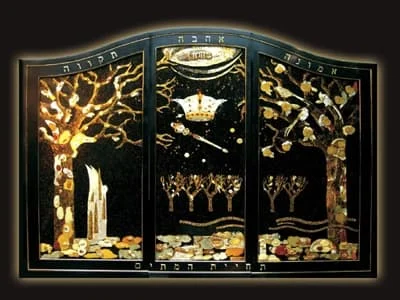
The following caskets from Myrta's studio are getting bigger and bigger. Adrianna completed in 1999 measures 46 x 60 x 41 cm and Gdansk from 2009: 66 x 69 x 44 cm. The trend of expanding size applies to all the objects created in this studio. The range of functions and themes to which the realised works refer is also expanding. Furniture, clocks, candelabras, vessels, figural sculptures and reliefs are created, and after 2000, paintings begin to dominate. The colour layer of the amber paintings from Myrta's studio, unlike the Russian icons discussed earlier, is applied not on wooden plywood, but on a sub-image of compressed dark amber. The colouring of the amber elements of the painting compositions, which is common among Russians, is not practised here, but the image is formed by selecting appropriate varieties of natural amber. The paintings, of which more than 100 were created in this workshop, proved attractive not only to the owner, but also to several buyers willing to bear the not inconsiderable cost of acquisition. The initial architectural subject matter of the paintings gives way first to striking floral compositions, to move on after a stage of portraits of the Myrt family to images of other people and finally to religious representations. Several times the scene is repeated Sermons on the Mount, and the religious cycle closes with a great triptych Tree of life measuring 365 x 280 cm.
Myrta's amber vases, vases and tankards are similar to their predecessors of 300 years ago, but usually 2 - 3 times larger. A several-litre tankard Rubens and an equally large vase can be seen in the collection of the Amber Museum in Gdańsk, which acquired 17 objects from Myrta's workshop for its collection. The largest dimensions were reached by two ebony, amber-encrusted cabinets: Sopot i Fish. Their height exceeds 4 metres, which is twice as high as the cabin of Augustus the Strong of Grünes Gewölbe.
However, the most valuable, most extraordinary work is the Amber Vault. Set on eight bronze legs is a five-storey wardrobe measuring 203 x 210 x 60 cm made entirely of pure amber elements. Some of the walls of the wardrobe have a triple layer, necessary due to the dimensions and weight. The thousands of elements of the cabinet are made in all the exquisite techniques of the late 17th/early 18th century, and the selection of unusual varieties of amber amazes and delights. The treasury is dedicated to Christ and is a confession of faith by the author.
Myrta's collection has so far preserved in a common collection the vast majority of works from his studio made over the past decades11. It is exhibited in the studio's Sopot headquarters, in specially arranged rooms. During the Polish Presidency of the European Union, it was visited by parliamentarians and members of the governments of EU countries.
Completion
Nowadays, amber used almost exclusively as a jewellery stone, and in jewellery that is not the most expensive, usually silver rather than gold, has a much lower social rank than three hundred years ago. The use of the raw amber material, which has been narrowed down to its role in jewellery, makes it impossible to invest in industrial mining, especially in the deeper Polish deposits. A profitable mine would have to extract at least 1,000 tonnes of amber a year, and jewellery-making does not create such a demand.
Without at least two equal mines competing in the raw material market, it will always be distorted by irrational monopoly decisions. Destructive supply spikes, price hikes, protectionism in sales and the constant corrupt phenomena against this background - it would be worthwhile to eliminate them at some point.
1. Janina Grabowska, Diplomatic careers of the Gdańsk cottons (in) POLSKA 1971 No 8
2. I give after Jacek Bielak from his doctoral thesis „Bursztynnictwo gdańskie od II połowy XVI do początku XVIII wieku” University of Gdańsk, Gdańsk 2007 : graph „Species structure of sold amber in the period of autumn/winter 1679/1680 (116 barrels)”.”
3. Jacek Bielak, ibidem, table „Combined data on the amount of raw material collected from 1568-1654 (in barrels)”.”
4. Jacek Bielak, ibidem, table „Quantity of raw material collected by the office of the Prussian Chamber between 1655 and 1705”.”
5. The cabinet of Augustus the Strong has the following dimensions: height - 210 cm, width - 108 cm, depth - 46 cm. Data from conservation documentation, Malbork 1968.
6. Alexander Zhuravlov, Amber Chamber - the beginning of reconstruction (in) Bursztyn - views/opinions, Gdansk/Warsaw 2005
7. Wiesław Gierłowski, Nikolaus Turow's Workshop in Gdańsk - School of the Grandmasters: Christoph Maucher, Gottfried Wollfram and Gottfried Turau (Turow) (in) Polski Jubiler nr 22, Warsaw, 2004
8. Mikhail Voronov and Anatoly Kuchumov, Yantarnaya Komnata, Khudozhinnik RFSR Leningrad, 1989
9. Zoja Kostiashova, История Калининградского Янтарного Комбината, Калининград 2007
10. Stanislaw Bernatt, And again you have to collect amber (in) Problemy R. 12 no. 9 Warsaw 1956
11. The number of catalogue items in the collection of products of Lucjan Myrta's workshop was, on 1.1.2013, 296. - 296. The amber wares and pure amber items in mixed constructions weighed a total of 3,954,620 grams, or almost 4 tonnes.
The article appeared in the publication summarising the International Symposium of Amber Researchers Deposits - Collections - Market during the fair Amberif 2013.