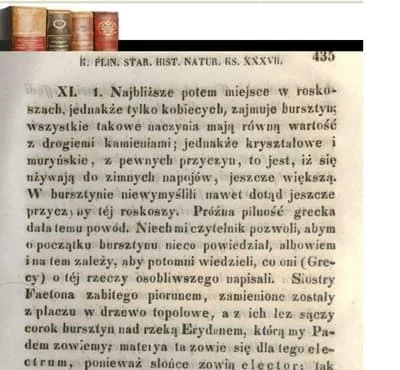
„Then the nearest place in pleasures, however only for women, is occupied by amber; all such vessels are of equal value with precious stones”. - this is how Pliny the Elder begins his story about amber in Natural History (Book XXXVII).
Why is amber valued by the Romans?
It was all the vanity of the Greeks that did it. So Pliny asks the reader to let him take a moment to tell the story of the origins of amber according to the Greeks. He begins with the myth of Phaeton, who was killed by lightning. His sisters „were turned from weeping into a poplar tree” and from them every year amber oozes over the Eridanus, which the Romans call the Po.
The Greeks called amber electrum (related from the word „sun”). Poets such as Eschylus, Philoxenus, Nicander, Euripides and Satyrus wrote about it in this way. Nicyas even considered it to be the juice of the sun's rays. He mused, that „these around the west press more violently into the ground and on this side of the ocean leave a fatty pót, which is then thrown up on the shores of Germania in summer”. In a similar way it is formed in Judea and Egypt, where it is called sakal. Pythias claimed that on the island of Abalus (a day's journey from the lagoon of the ocean, which the Germanic people inhabit) in autumn the ramparts „bring amber” along with the impurity of the sea. This was also mentioned by Timaeus, only the island was named Basilia. Theochrestus and Xenocrates claimed that the ocean dumps it on the Pyrenean capes. According to Asarubas, on the other hand, „by the Atlantic sea is the lake Cephisias, which the Moors call electrum”. Dried by the sun, it gives off a floating amber from the silt. Mnaeas claims the same, but situates the amber-giving place in Syceon in Africa. Theomenes, on the other hand, claims that „around Sirte is the garden of the Hesperides, from which amber on the mud falls and is collected by the Hesperide virgins”. In Syria they call it harpax because it attracts leaves, stalks and fabric fibres. The Syrian women make guardas with it (probably referring to loops of string with large amber buttons strung on them that spin when the string is stretched with the fingers), the Indom is more pleasant than incense. Ctesias even points out in India to the river Hypobarus („everything in it contains”), flowing from the north towards the eastern ocean along a mountain „on which amber-bearing trees grow” (called „siptachore” - a pleasant sweetness). Mithridates, too, shared this view, although in his opinion amber leaked from trees of the cedar genus that overgrew the island of Osericta on the shores of Germania. Sudines and Metrodorus, on the other hand, point to trees in Liguria.
Poets don't need to know geography
Some of the Greek poets were of the opinion that the electrum (amber) islands lay in the Adriatic Sea and that the Po flows towards them. Sotakus, on the other hand, claimed that amber flows from the electrodes, rocks in Britain. Pliny the Elder ridicules such a view, as do the claims of Eschylus that it is in Spain that the Eridanus, also called Rhodanus, flows. Lesser-known Greek writers also spread false information about the origin of amber: and that there are trees on the inaccessible rocks of the Adriatic Gulf from which amber seeps. According to Theophrastus, amber is dug in Liguria, according to Chares in Ethiopia, because Phaeton died there and his temple is located there. According to Philemon, amber gives off a flame, comes from Scythia and they dig it in two places: in one white and waxy in colour (they call it electrum), in the other yellow, which they call subalternicum. This was confirmed by Xenocrates, who stressed that the Scythians call amber sacrium because it is born on their soil.
From the sea, wood or urine of wild animals
Demostratus, on the other hand, calls amber „lyncurion” and claims that it is formed from the urine of wild ostraca: yellow and fiery are the work of males, white and faint are the work of females. Others claimed that there are languriae or langae animals in Italy, which live on the Po River, and it is to them that amber is due. The author of „Natural History”, with his usual irony, lets the reader know that all the Greek poets mentioned do not need to know about geography and nature, so they should be forgiven all this „ignorance”. With the exception of one Greek.
He forgives everyone, but not Sophocles
„All are surpassed by Sophocles, the tragic poet, which surprises me with his kind of writing and fame being so serious.” - Pliny the Elder states with his usual wit. In his opinion, minor poets can be forgiven their ignorance, but not Sophocles. The native Athenian, who was in public and military service, maintained that amber was created at the end of India in the lairs of Meleagrid birds mourning Mealegra (a participant in the expedition of the Argonauts, he killed a Kalidonian boar and offered the animal's skin to the Atalanta. This did not please his mother Altea's brothers. As a result of the altercation, Mealeger killed them, and an embittered Altea burned the torch accompanying her son's birthday, causing his death).
How could he believe this,„ Pliny marvels: ”Can a child be found so foolish as to believe that birds for centuries have wept such great tears? That birds from Greece, where Meleager died, went to weep to India? But well, don't poets say many other fabulous things?„ - asks, seemingly magnanimously, the author of Natural History. But when it comes to material things - jokes come to an end and generosity has its limits. According to Pliny, if one preaches seriously about matter, one turns out to be ”a great scorner of men and an unbearable, unpunished liar!„.
There are certain things
Having dispelled all Greek superstitions, Pliny the Elder gets down to business in grand style: „It is a certainty that amber is born in the islands of the Northern Ocean and is called glessum by the Germans (...). It is born from a flowing core, like gumma from cherries, or resin from pines, trees of the pine kind.(...). Our fathers called it succinum in the idea that it is the sap of a tree. That it comes from a tree of the pine genus is evidenced by its pine-like aroma and the fact that, when lit, it burns like an arch and smells. (...) The reason for this fairy tale being attached to the Po seems to be that to this day female Trans-Padon peasants wear amber instead of necklaces, mostly for decoration, but also as a medicine; as they believe it prevents suppurative diseases and sore throats”.
Expedition for amber to decorate the Games
As reported by Pliny, almost 600,000 steps from Carnutum in Pannonia (Roman military camp and provincial capital Panonia, currently located in the north-east of the Austria) lay a Germanic shore from which amber was brought. It had recently been discovered, for Julianus, who was entrusted by the Emperor Nero with the organisation of the fencing games (it was about gladiatorial combat), sent there „a Roman knight for the acquisition of amber”. This soldier so learnt to trade in amber that he „ran along the shores and brought back so much amber that in the nets to keep the wild beasts from the balcony of the servants, knots were made of amber; and the weapons and the maces and all the day one equipment were of amber. The largest lump he brought weighed 13 pounds (about 6 kg)”.
Amber hair fashion
One more credit for the promotion of amber went to the Emperor Nero. In the Natural History we find mention of the fashion for amber hair. In one of his poems, Nero referred to his wife Poppea's hair as „succina”, and since, as Pliny the Elder states, not without malice, „reprehensible things such as these are never dispensed with by such costly names, therefore the matrons acquired a taste for this, as it were, third colour” (until then blonde was the most fashionable colour - author's note).
Amber from India
Pliny the Elder dwells on amber coming from India. He cites Archaeus ruling Cappadocia, who claimed that raw amber was brought from India, attached to pine bark, and refined by boiling it in „the fat of a suckling pig”. In the process, things such as ants, mosquitoes and lizards appear, which can only testify that they „clung to the liquid amber and were confined when it solidified”.
There are many types of it
White ambers have the most exquisite scent. This, as well as those of a waxy colour, have no price. But the yellow ones are the most valued, states Pliny the Elder. Among them, the most transparent ones are appreciated except for those that are too bright and fiery. „For one likes the image of fire, not the fire itself,” writes the author of the Natural History.
The famous Falere amber
Amber, named after the colour of Phalerean wine, is the most famous, transparent and of a mellow lustre. Some also like the colour of boiled honey. Phalerene wine was famous for Campania, a historical land in Italy located in the southern part of the Apennine Peninsula (the name comes from the Latin Campania felix, meaning „happy country”). The main cities of Campania were Capua, Naples, the port city of Puteoli (today's Pozzuoli) and Pompeii.
On amber dyeing and amethyst adulteration
We also learn from Pliny the Elder that the Romans dyed amber with goat's tallow, conchylia dye or the root of the redwood, better known to us as the common centurion or common thousandths. Pliny also mentions that ambers rubbed with oil burn brighter and longer than linen core. Amber was also used to adulterate expensive transparent stones, especially amethysts.
About the therapeutic properties
The Romans also used amber in medicine. Children were attached to them as amulets. According to Callistratus, at any age amber works well against insanity and urinary problems. A special variety of it called „chryselectrum” of a vaguely golden colour tied to the neck was said to cure fevers and other illnesses; it was rubbed with honey and rose oil for ear diseases. „But this is not why amber pleases women,” - Pliny the Elder states. „They value amber so much in antique equipment that the figure of a small man is more expensive than the living, healthy man himself!” - declares Pliny the Elder. Why is this the case? The entire argument should be quoted here for its brilliance: „In Corinthian vessels we like bronze mixed with gold and silver, in sculptures we like art and wit (...), we esteem pearls because we wear them on our heads, precious stones because they are on our fingers, finally, in all other superfluities we like ostentation or utility, while in amber we like only the conviction that one possesses valuables”. May the elegant women of the world, with our help, begin to imitate the ancient Romans in this respect!
All quotations are from K. Pliny the Elder's „Natural History ”j books XXXVII = C. Plinii Secundi Historiae naturalis libri XXXVII. T. 10, pp. 34-37 - Plinius Secundus, Caius (23-79), translated into Polish by Józef Łukaszewicz, published in Poznań in 1845.
Robert Pytlos is the coordinator of the Mayor of Gdańsk for amber and a journalist who, in the times of amber.com.pl, facebook and twitter, reaches out to source texts about amber. He brings us closer to areas of the amber terra incognita, hitherto inaccessible to him as a fairly average amber enthusiast, and known to us only from a few quotations in press and scientific publications, on paper and on the internet.