Development of craft workshops
With the incorporation of Gdańsk to the Republic (1466) and the establishment of the amber guild in 1477, craftsmen of this speciality, hitherto deprived of opportunities for development due to the strict restrictions imposed by the Teutonic Knights“ administration, were able to start working legally. Casimir Jagiellon granted Gdansk the ”amber-bearing" areas around the city, especially the Vistula Spit. The rapid development of craft workshops, however, meant that the raw material soon became scarce. It began to be imported illegally from Sambia, which belonged to the Order, resulting in a long-standing feud with the Teutonic Knights. The Teutonic Knights, who had resided in Königsberg since 1457, even demanded that the Polish king abolish the guild. However, they finally incorporated the Gdansk corporation into their trade organisation (1483). In 1533, the import of amber from the newly established Ducal Prussia was handled by the Jaski family from Gdansk. This privilege was signed by the last Teutonic Grand Master and, since the secularisation of the Order, the first secular ruler of Prussia, Prince Albrecht Hohenzollern. Despite insufficient supplies of raw material from its own deposits under the control of first the City Council and then the guild itself, as well as problems with the Jaski's monopolistic policy, the Gdańsk amber industry developed dynamically and found more and more new, wealthy customers. Apart from the wealthy bourgeoisie, amber products were bought by the nobility, the magnates and the clergy, and soon the beauty and uniqueness of these works was appreciated at the royal court as well. With time, it became customary to order magnificent, richly decorated wares or entire sets, such as tableware, from Gdańsk amber makers, which the royal envoys took to distant countries as diplomatic gifts from the Polish rulers. Over the next two centuries, amber masterpieces created in the workshops of Gdansk and Königsberg found their way into the treasuries of many European monarchs and princes; many magnificent gifts made their way to Russia and Turkey.
Amber works from the 16th century
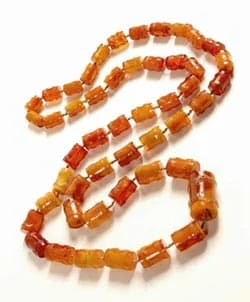
The range of products manufactured in Gdansk changed with the Reformation movement, which arrived here from the second quarter of the 16th century. Devotional items, which had dominated production until then, gave way to objects of everyday use and luxury trinkets. The papal legate Cardinal Francesco Giovanni Commendone (1563), who was disgusted by this state of affairs, wrote of amber “chests, spoons, vases and birdcages”. Very few works from this period have survived in Polish collections, among them a figure of the Madonna on a crescent from an Oliwa workshop (Częstochowa, Pauline monastery on Jasna Góra) and a heart-shaped medallion with a portrait of Stefan Batory, found in the tomb of Anna Jagiellonka (Kraków, Wawel Cathedral treasury). In the Castle Museum in Malbork there are two unique examples of Renaissance amber jewellery dating from the 16th/17th centuries. - a fragment of the necklace of Sybil Dorothea, Duchess of Brest, and a necklace for men's attire made of cylindrical beads with carved garlands.
Most of the amber works from the 16th century that have survived to the present day are of Königsberg provenance. At the court of Duke Albrecht, a well-known lover and patron of the arts and sciences, many court amber artists worked. With access to the largest amber deposits in the world, they had the opportunity to choose the most attractive material. “I have seen lumps of amber the size of a human head, from which his highness the Prince of Prussia ordered spells and goblets to be made,” - wrote in the mid-16th century Andreas Aurifaber, the duke's personal physician and author of a comprehensive monograph on Baltic amber (“Succini historia” 1551).
By the time the guild was established in Königsberg (1641), the “court” amber makers had already gained a well-deserved reputation. From the archival accounts of the Königsberg court, an assortment of items produced by them emerges; these included small vessels (goblets, bottles, tins), chessboards, cutlery with ivory handles, ornaments, sculptures, and settings for small objects. A set of 18 silver platters with amber bottoms, made in 1585 by the Königsberg goldsmith Andreas Kniefel and the amber maker Stenzel Schmitt, is preserved at Rosenberg Castle in Copenhagen. The 16th-century “spells and cups” described by Aurifaber can be seen today in some European museums, such as the Schatzkammer der Residenz in Munich, the Staatliche Kunstsammlungen in Kassel, the Ostpreussisches Landesmuseum in Lüneburg and the Kunsthistorisches Museum in Vienna.

Development of the amber craft in the 17th century
Generally speaking, 16th century amber wares were small in size, as for technological reasons they were usually made from a single block. However, from the beginning of the 17th century, a new processing method developed by Georg Schreiber, an amber craftsman from Königsberg, determined the further development of this craft and made it possible to make the objects produced significantly more attractive. It consisted of cutting thin plates of amber, decorating them with shallow reliefs and then joining them directly together (“keyed”, using adhesives or silver bands). In this way, some of the most beautiful pieces of Gdańsk and Königsberg amber work were created: caskets, tankards, jugs, plates and goblets. Transparent amber specimens were selected for their manufacture, through which scenes and ornamental motifs engraved from the bottom shone through. To emphasise their brilliance, gold foil flakes began to be placed under the engravings (eglomisée technique). Ivory began to play an important role. It fulfilled both a functional and a decorative role. On 17th-century amber wares, it usually appears in the form of relief plaques with biblical or mythological scenes, figures of saints, panoplies and floral motifs.

Around the middle of the 17th century, amber wares began to be constructed using wooden skeletons. It was a decidedly easier technique, but one that was ultimately effective, as it made it possible to make works that were much larger than before. Thus, several-tiered household altars, caskets, cabinets with drawers for trinkets, and various table games were created. The wood was covered with tiles of amber cut in the form of various geometric figures; these tiles, due to the multicolour nature of amber, created a wonderful mosaic of warm colours. In the central areas of a casket or altarpiece, engraved medallions of clear amber on gold foil, bone reliefs or full-bodied sculptures were placed. The Baroque splendour of such wares is most evident in the works of the most distinguished masters, especially famous for their sculptural works: Jacob Heise from Königsberg and Michel Redlin and Christoph Maucher from Gdansk. Owning unique wares made of “Baltic gold” even became fashionable among the highest levels of society. Some rulers employed amber artists at their courts (e.g. Copenhagen - royal castle, Kassel - court of the Hessian landgraves) and allocated their wares to the court “kunstkammmer”, where they could be admired alongside other works of art and various exotic curiosities kept there.
Amber Room
The most famous work created to royal order is undoubtedly the Amber Chamber. Frederick I, King of Prussia, wanted to outdo everyone else with the grandeur and originality of his idea for a work of amber. At his request, the royal court architect Andreas Schlüter drew up a design for a cabinet entirely lined with this raw material. In 1701, Gottfried Wolfram, the amber designer of Danish King Frederick IV, was drawn from the Copenhagen court to realise the project. After six years, he was replaced by two artists from Danzig, Gottfried Turau and Ernst Schacht. In 1713, Frederick William I, the son and successor of Frederick I, known for his stinginess, ordered a halt to the already very advanced work. The finished parts of the wall cladding were packed in crates and deposited in the warehouses of the Berlin armoury. Three years later, they were given as a gift to Tsar Peter I of Russia. The Amber Chamber was completed decades later at the palace in Tsarskoye Selo. Italian, Königsberg and Russian masters worked on its completion, and the final result differed significantly from the original design, mainly due to the much larger size of the interior, as well as new Rococo art trends. The three amber walls were embellished with mirrored pilasters, gilded sconces for hundreds of candles, four large mosaics of Urals and Caucasian stones, carved supra-ports above the doors, and a large painting frieze imitating amber above the whole.
The Amber Chamber is considered the crowning glory period of the modern amber craft. Already in the 1st half of the 18th century, there were symptoms indicating its slow decline. This was caused both by problems with raw material and a decline in demand for luxury amber products. More buyers were finding trinkets and trinkets: boxes and snuff boxes, flacons, cases for sewing tools, cane holders, powder cones and toiletries holders. It was not until the second half of the 19th century that the European amber industry experienced a renewed, though no longer spectacular, boom.
At the site of the Amber Room, which was lost during the Second World War, its reconstruction has been on display since 2003, while relatively few preserved original works from the heyday of this art form can be found today in some European museums. The Rosenberg Castle in Copenhagen, the Royal Treasury at Stockholm Castle, the Kunsthistorisches Museum in Vienna, the Victoria & Albert Museum in London, the Museo Argenti in the Pitti Palace in Florence, the Russian collections in the Hermitage and Tsarskoye Selo, and the German collections in Dresden, Munich, Kassel and Lüneburg boast the best collections. In Poland, the most valuable collection of ancient amber wares is held by the Castle Museum in Malbork.