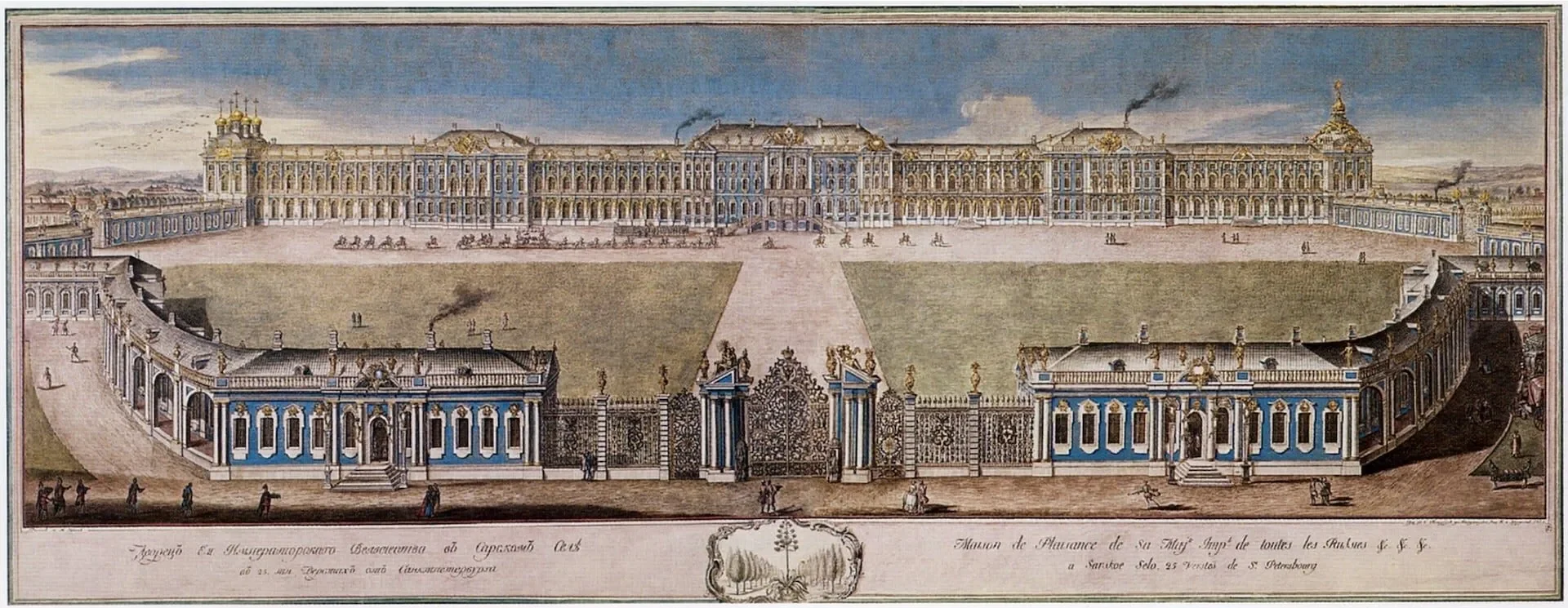
The decision to build the palace was taken in the mid-18th century by Peter I's daughter, Empress Elizabeth I. She entrusted its realisation to her Italian court architect Francesco Bartolomeo Rastrelli. It was in this palace that Rastrelli located the Amber Room, and next to it the largest amber workshop in Europe at the time, where up to 200 people worked simultaneously until the end of the 18th century.
This workshop not only supplemented and completed the decoration of the walls of the Amber Chamber, but also carried out conservation tasks on other large amber objects from the tsar's stock, obtained through donations, purchases and, most often, contributions from countries and cities occupied by the Russian army. Earlier objects collected in the Moscow Kremlin, the seat of the tsars before the capital was moved to the Neva, were referred to her.
This created the world's largest collection of European artistic amberwork.
However, the quality of the conservation efforts of the Tsarskoyev workshop was not the best. There is archivally confirmed news of at least seven large cabinets and cabinetry from the Danzig and Königsberg ateliers over which here
worked after 1765 and then disintegrated in a fairly short period of time, already before 1830.
A large table for 12 people made at Tsarskoye Selo in the 1770s, using a similar technique to the cabinets of lining the wooden structure with thin amber tiles, did not even last 50 years.
Only one piece of modern amber furniture, or rather a piece of furniture, has survived to the present day in the collection of the Catherine Palace, namely a table chest measuring 55 x 34 x 31 cm. This chest of drawers, which belonged to the bench of the City of Gdansk, was seized in 1734 by the Field Marshal of Empress Elisabeth I, Brukchard Christopf von Münnich, as a contribution to the contribution for abandoning the siege. It is worth noting the excellence of the technique of arranging the beautiful, multicoloured mosaic composition on the wooden frame of the chest of drawers, using an insulating and separating layer of foil and paper between the wood and the amber. It is with some regret that Danzigers look at the front wall of the furniture. It depicts the silhouettes of the lions of the coat of arms and a faithful panorama of Gdańsk engraved on the underside of a large, elliptical cabochon.
At present, the Catherine Palace collection comprises some 200 exquisite objects. It is presented in its entirety in the rooms adjacent to the Amber Room, in an exhibition called “A Look Through the Centuries”. The exhibition catalogue includes 238 items, as, in addition to the amber works, original documents and engravings depicting the history of the collection are presented.
All the monuments look magnificent, as they underwent thorough conservation in the 1980s, during which most of the objects were dismantled, individual details were restored and conserved, and all defects were carefully filled in. In this way, Russian specialists gained the experience needed to reconstruct the lost decoration of the walls of the Amber Room on concrete historical material.
Earlier in 1911-13, most of the collection had undergone salvage conservation at the Danzig-based company “Moritz Stumpf”.
Gdańsk caskets
The four large caskets from the Gdansk workshops best illustrate the splendour of artistic ambering in the 17th and early 18th centuries. Three of them, seventeenth-century ones, are classical pure amber constructions, without wooden framework, built with doubled walls. This ensures the strength of the large objects made of the fragile material, and, as it were, also doubles the form and content of the decoration: an eyeful on the outside and an equally careful though now inaccessible to the viewer artistic composition of the caskets“ interiors. Kings and princes, former recipients of ”diplomatic gifts", could nevertheless enjoy the sight of all the charms of the gifts they received.
The oldest and largest casket, dating from the mid-17th century, impresses with its volume (over 50 litres) and the variety of colour varieties of amber used. It appeals to the viewer with its colour composition rather than the variety of sculptural forms and architectural elements. On closer inspection, however, it reveals the full range of sculptural techniques: figural, relief and intaglio.
An extremely interesting object is the casket with the nymph Dione, the patron saint of sailors, on the lid. It was probably the one described and drawn in his diary by the Danzig councillor Schröder as having been made in a workshop next to St Catherine's Church and estimated at the time at 3,000 thalers. It has a distinctive high lid with ornaments engraved in transparent plates.
The third Gdansk casket is very characteristic of the work of the senior amber guild Michel Redlin. It is multi-storied, very complicated in form, built as if with a disregard for the cohesiveness of the structure. It is actually something in-between a chest and a piece of furniture (drawers, separate opening tiers, high legs). It is doubly valuable, as Redlin's own hand-drawn design has survived. Its large dimensions and elaborate form make it extremely expressive.
Another large casket is of importance to the Tsarskoye Selo collection. Although it has a slightly less highly prized construction on a wooden plinth than the previous one, only on the surface clad with an amber ornament of fleshy acanthus leaves, it is a rare example of a clearly signed and dated work.
During conservation work in 1983, a sheet of paper was discovered between the layers of its bottom with the notation: “Gottfried Turau - Inventor et fecit - Anno 1705 12 Iulius”. This is the author's signature of one of the main executors of the decoration of the walls of the Amber Chamber, which cleared up many doubts when editing the details during the reconstruction work. The casket was probably ordered by the Radziwill family, as it was requisitioned by Field Marshal Suvorov at their castle in Nesvizh a century later and handed over to the Tsar's collection.
Interesting facts from the Gdansk workshops
Most interesting seems to be the large chessboard (46 x 43 cm ) from the end of the 17th century, in which half the fields are transparent and the bottom is carved intaglio. In 1991, when it was completely dismantled for conservation, I had the opportunity to copy with precision the scenes and French inscriptions from the carved tiles of 40 mm . I hoped to read and understand the content of some larger story contained in the 32 scenes and the supplementary notes. In the end, however, it turned out that they were quotations from a French game of flirtation, witty and paradoxically put together.
The Tsarskoye Selo collection contains another example associated with the play so fashionable in the late 17th century. A large casket decorated with carvings and superbly composed in terms of colour, it contains 4 smaller ones with nearly a hundred amber fissures with inscriptions and figural depictions. Such an extraordinarily expensive but visually and tactilely pleasing set could satisfy the most capricious connoisseurs.
Collection of luxury items
The collection of artistic amber artefacts at Catherine Palace, although so numerous and rich, is completely devoid of the sacred objects present in all other major museum collections.
There is a testimony to the lifestyle of the Tsar's court during the reign of the notorious, self-possessed, and all too casual women on the imperial throne: Catherine I, Anne, Elizabeth I and Catherine II. It is full of cosmetics boxes, make-up instruments, luxury briefcases, dress and table ornaments. All impressive in their grandeur, artistic craftsmanship and precision of execution, but not in the content of their representations or references to moral or religious models. Even love, the main focus of interest, manifests itself either conventionally, in carved pairs of Venere and Cupid, or playfully in flirtation fiches.
When the male tsars came into power and power in the 19th century, the function of the objects in the collection changed. The so-called “bachelor's set” - a bowl formed in the shape of a large scallop and a pair of shaving utensils - remained from the entire output of the great Tsarskosel amber workshop.
From purchases and donations, however, a sizeable collection of pipes and nargles, Asian water pipes, has been assembled. The collection is not currently being added to, as it is treated as a certain historical entity.