
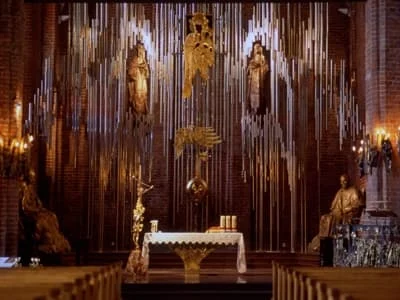
Today, in St Brigid's Basilica, we can see a copy of the icon of the Jasna Gora painting, where the Virgin Mary is dressed in a dress made of a unique variety of white amber. The Madonna and Child also have amber crowns, and at their feet an eagle takes flight, symbolising Poland. An element of the altar is also the Amber Monstrance by Mariusz Drapikowski, which impresses not only with its artistic concept but also with its height - 176 cm. This is only a small part of the project that has been realised. Why only so much?
The biggest obstacle to the whole project is the difficulty of access to amber and its very high prices. When the concept for the monumental amber altar was created in 2000, the raw material was readily available and its prices more than twenty times lower than today. Even then, it was estimated that about 10 tonnes of amber would be needed to build it. Today, this would be a cost of more than 200 million zlotys - impossible to be borne either by the Gdansk amber workers, who have been the main sponsors of the raw material so far, or by the parish. Trouble with the raw material a decade ago prompted Monsignor Jankowski, the initiator of the altar's construction, to look for sources of amber other than donation - hence his frantic efforts to obtain a concession to mine amber from deposits in the Vistula Marshland. „The amber community strongly supported this idea, especially as it was a great chance to gain access to the raw material for our production needs as well,” - Wojciech Kalandyk recalls. Unfortunately, the change of government and the media's campaign against prelate Jankowski strongly contributed to the suspension of work on the altar. The removal of the prelate from his post, which was held by successive administrators, also did not create favourable conditions for the continuation of the project.
The amber community did not lose hope after all and decided to take the matter into their own hands. In 2005, the Amber Altar Foundation was set up with the aim of „initiating and supporting the construction of an amber altar in St. Brygida Church in Gdańsk as a cultural heritage of the Polish Nation and popularising the idea of amber as a Polish speciality”. Unfortunately, these postulates had no chance of being realised due to the lack of raw material. The Foundation was dissolved.
„The amber altar is a monumental object with a tremendous charge of past events, so all the more reason for its construction to continue. It is necessary to take the next step, adjust the project to market realities and implement it, even if it will be done in small steps,” claims Wiesław Gierłowski, doyen of Polish amber artists.
Small steps are being taken. Currently two reliquaries of Blessed Father Jerzy Popiełuszko and St John Paul II are being made, the first one in the atelier of Mariusz Drapikowski - the author of the altar project, and the second one in the atelier of the sculptor Professor Radwański - whose team realised the project. Will they be made of amber? „I would very much like to, but in today's reality, when amber of good quality and in large lumps - which is what we need - exceeds the price of gold, it is not possible. But amber in general cannot be missing in these reliquaries, it will be juxtaposed with silver and gold and coloured stones,” - Drapikowski explains. Both are expected to be ready for 31 August this year, when St Brigid's Basilica will celebrate the commemoration of the workers’ strikes of August '80.
Are they part of the original altar design? „Since we already know that we will not be able to build the altarpiece entirely out of amber, there are at least a few ideas for a continuation. Currently, reliquaries are being created from votive donations, and we do not know what the next elements will be. The most important thing, however, is that the work continues,” says Drapikowski.