„He started his adventure with jewellery in my workshop in the 1970s. Many people passed through it, but Janusz stood out for his exceptional talent,” recalls Giedymin Jablonski. Not only did he have exceptional talent, but he was also very committed to pursuing his passion for jewellery: in difficult times for goldsmiths, he had amassed an impressive library of literature dedicated to jewellery design and making, he was very well informed about what was happening on the goldsmithing scene behind the Iron Curtain, and he was constantly perfecting his workshop, also looking for his own technological solutions. „Janusz was an aesthete by nature. In his work, he focused on form and composition. At the same time possessing a perfect and versatile workshop, he was like a poet who speaks in beautiful language about the essence of beauty,” Giedymin Jablonski concluded.
„Janusz had an incredible intuition, a rare sense of proportion and a great command of the principles of composition”. - recalls Piotr Wajcht, who explored the secrets of goldsmithing in Wosik's workshop. He was not the only one, as many people learned the basics of goldsmithing from him - at a time when everyone gained skills on their own and worked out the technique on their own, Janusz was happy to share his knowledge. Friends recall that his studio was vibrant - artists representing various fields of art, not just goldsmiths, would meet there. „He helped many people who were taking their first steps in goldsmithing, by no means on a master-apprentice basis, but simply in a friendly manner. He gave hints, inspiration, let us watch him work, and gave support also at further stages of the professional path”. - explains Wajcht.
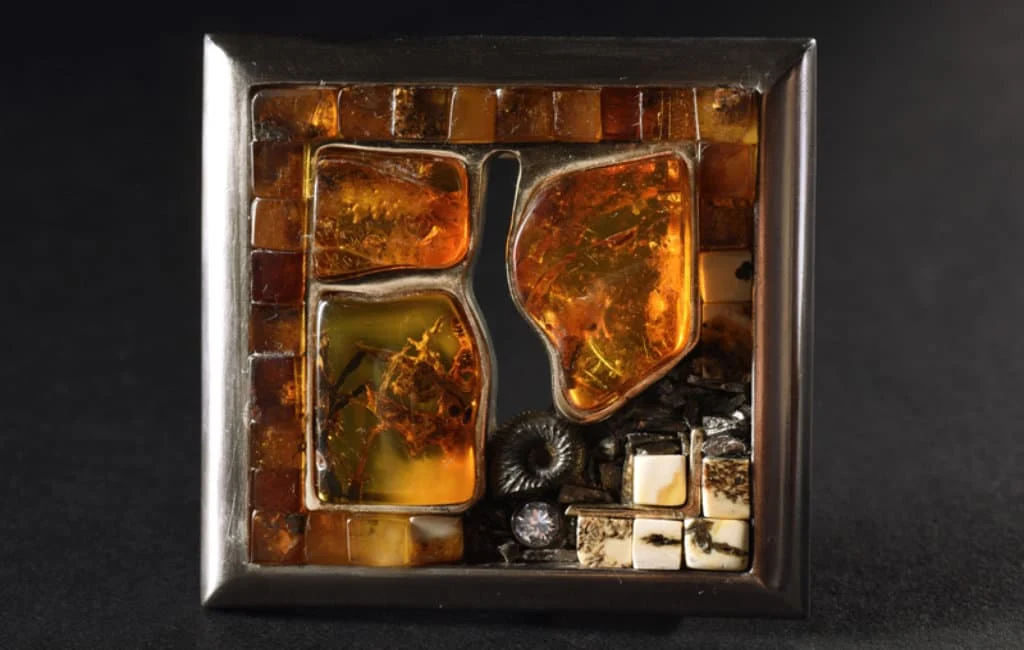
Back in the 1970s, when artists avoided amber, considering it a stone so far depreciated as to be unworthy of an artistic setting, Janusz was able to extract amazing effects from it. Most characteristic of his work are brooch-pendants in the shape of squares filled with eclectic mosaics, in which Baltic amber was the most frequent element. By his own admission, these forms were inspired by the jewellery of German goldsmith Michael Zobel.
Janusz Wosik's achievements remain largely unknown, as he very rarely took part in competitions and exhibitions, and has not exhibited at Amberif for many years. Over 40 years of work, which, as Danka Wasielewska points out, was his greatest passion, there must have been many of them: most of them went to foreign buyers. One of his works is in the Museum of Jewellery in Pforzheim, while his brooch-pendant from the series „Short Stories”, created in the late 1990s, is in the collection of the Amber Museum, a branch of the Gdansk Museum.
A farewell Mass for Janusz Wosik will be held on Thursday, 14 June, at 11.00 a.m. in the Star of the Sea Church in Sopot. Burial in the chapel at the Catholic cemetery in Sopot on Malczewskiego Street at 12.00.